
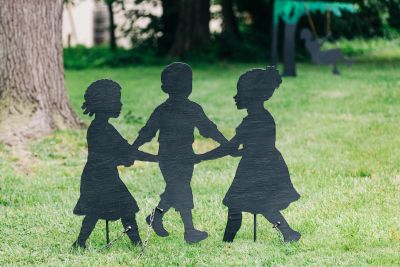
"Each day as I worked on the silhouettes, I felt the children coming to life in my yard. One by one, they appeared to play, learn, create, and dream. It felt as if they were joyfully declaring, “We were here.”
In 1860, nearly half of the approximately four million enslaved people in the United States were under the age of 16. That was almost two million children.
When we think about the horrors of enslavement, we often picture adults. Realizing that so many of the people who endured its violence, forced labor, separation, and cruelty were children broke my heart in an entirely different way.
Childhood Interrupted remembers them not only through what happened to them, but through who they were. They laughed. They played. They imagined. They found moments of joy in a world determined to deny them freedom."- Hannah Drake
Q. Who do the silhouettes represent?
The silhouettes represent Black people whose lives, stories, and humanity have been hidden by history. Some portray specific individuals, while others give presence to the countless people whose names, faces, and personal stories were never preserved.
They are not imaginary. They represent people who lived, loved, worked, resisted, created, dreamed, and shaped the world around them, even when history failed to carry their stories forward.
Q. Why are the silhouettes faceless?
The silhouettes are faceless because I did not want them to represent only one individual. By leaving their faces open, I invite viewers to see whoever they need to see: an ancestor, a relative, a friend, someone they have lost, or even themselves. The absence of a face does not erase the person. It creates space for connection, imagination, and remembrance.
Q. Why are the children shackled?
The children are shackled because they were enslaved. The shackles ask us to hold two truths at once: they were children, deserving of play, imagination, wonder, and joy, and they were also enslaved. Those truths can be difficult to hold together, but that discomfort is intentional. The installation does not ask us to see these children only through the violence inflicted upon them, nor does it allow us to imagine their childhood without acknowledging the reality of enslavement. Their humanity and their bondage existed at the same time.
Q. Why are the figures rendered in black?
The figures are rendered in black because they are meant to resemble shadows. A shadow signals that someone is present, but it also marks an absence. That tension reflects how Black people are often remembered in history. Their labor, influence, creativity, and suffering are everywhere, while their names, faces, voices, and personal stories are frequently missing.
The silhouettes make that contradiction visible. They occupy the landscape while reminding us of the people history refused to fully see.
Q. What do you want people to feel when they encounter the silhouettes?
I want people to recognize and feel the humanity of enslaved Black people and Black people more broadly. I want them to see beyond categories, statistics, labor, and suffering and remember that these were people with inner lives, relationships, fears, hopes, joy, and dreams.
When someone stands among the silhouettes, I want the distance between the past and the present to narrow. I want them to pause and consider, even briefly, what it meant to live, love, raise children, create, hope, and dream while being denied freedom.
No one who has not lived through enslavement can fully understand how it felt. But we can allow ourselves to feel enough to care, to remember, and to respond.
Q. What is the relationship between Echoes in Silhouette and Childhood Interrupted?
Echoes in Silhouette is the larger body of work that brings Black lives and histories out of the shadows. Childhood Interrupted, which centers the lives and humanity of enslaved children, is the first series within it. While creating Childhood Interrupted, I realized that the silhouettes could hold far more stories. There were freedom seekers, laborers, artists, survivors, and countless others whose lives had also been hidden, diminished, or left untold. I began asking myself how I could use this art form to bring even more of their stories to life.
That question became Echoes in Silhouette. Childhood Interrupted was the beginning, not the boundary.
Q. Can an organization or historic site host an installation?
Yes. Echoes in Silhouette installations can be presented at historic sites, museums, schools, cultural institutions, galleries, and other public spaces.
Organizations may host Childhood Interrupted, a traveling installation featuring approximately 30 life-size silhouettes and accompanying historical signage. I am also open to conversations about site-specific installations that illuminate Black lives and stories connected to a particular place.
Each installation is thoughtfully arranged to respond to the history, landscape, and community of the host site. To begin a conversation about bringing an installation to your space, please complete the contact form.